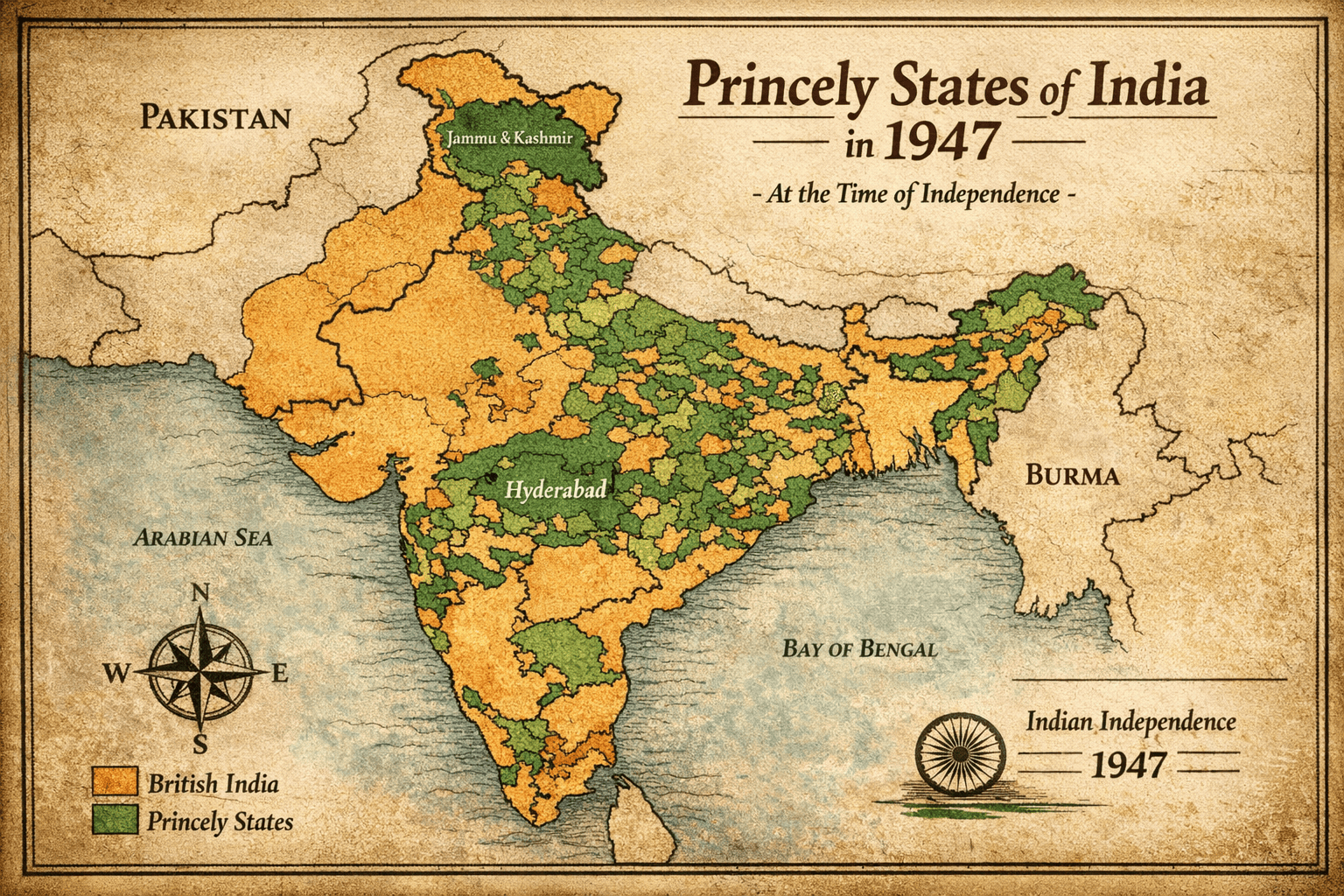
Princely States Of India 1947
When India became independent in August 1947, the country was not one single unit on the map. Along with the British-ruled provinces, there were hundreds of “princely states”—regions ruled by Indian kings, nawabs, and maharajas under British influence. These princely states were not directly ruled by the British, but they were linked to the British Crown through agreements and British “paramountcy.” (Encyclopedia Britannica)
Most sources describe the number as over 560 states, often stated as about 565 in the subcontinent at the time of British withdrawal. (India State Stories)
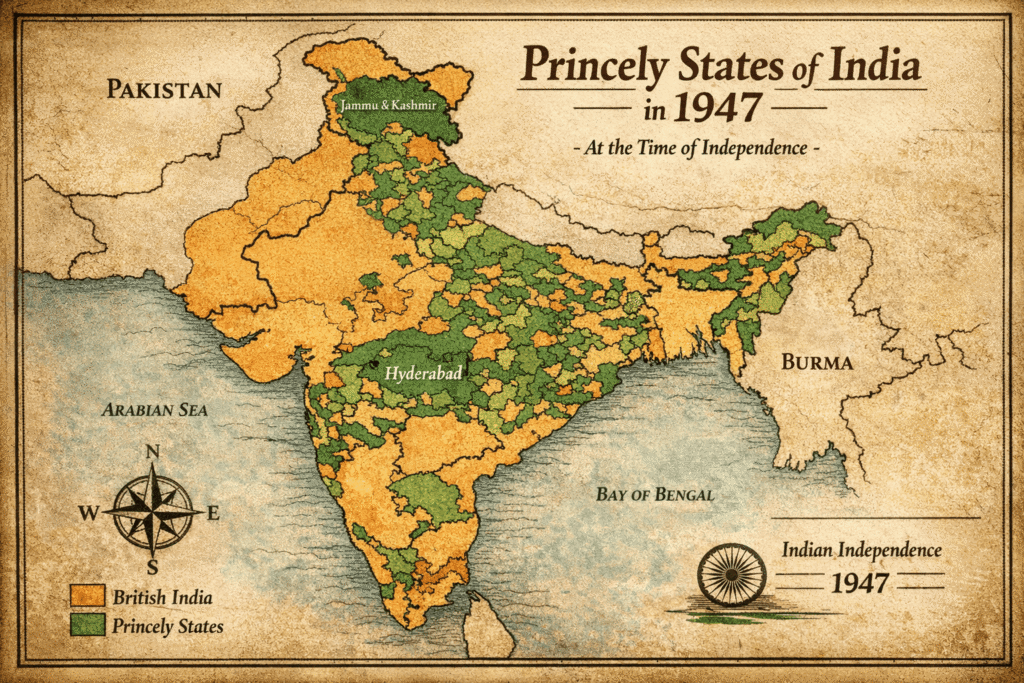
What Were Princely States?
Princely states were nominally autonomous territories ruled by local monarchs. Britain controlled key powers through indirect rule, while many rulers managed internal matters in their own territories. Britannica notes these states covered about two-fifths of the subcontinent during colonial times. (Encyclopedia Britannica)
What Changed in 1947?
A big legal change happened because of the Indian Independence Act, 1947. This Act ended British authority and also ended the British Crown’s suzerainty/paramountcy over princely states from 15 August 1947. That meant the old treaties and obligations between Britain and the princely states ended. (Legislation.gov.uk)
In simple words:
After 15 August 1947, princely states could not rely on Britain anymore. They had to decide their future.
What Options Did Princely States Have?
After British paramountcy ended, princely rulers had three basic choices:
- Join India
- Join Pakistan
- Try to remain independent
However, in real life, staying independent was very difficult because defence, foreign relations, and communications needed strong support. (Legislation.gov.uk)
How Did Most Princely States Join India?
Most princely states joined India by signing a legal document called the Instrument of Accession. This usually gave the new Indian government power over Defence, External Affairs, and Communications, while the ruler kept control over many internal matters at first. (India State Stories)
The Indian government preserved these original documents, and the National Archives of India has even showcased them through exhibitions focused on Instruments of Accession & Merger. (Press Information Bureau)
Key Princely States People Often Talk About
Most states joined smoothly, but a few became well-known because their decisions created serious political challenges:
1) Hyderabad
Hyderabad’s ruler (the Nizam) initially aimed to stay independent. In September 1948, India carried out Operation Polo, after which Hyderabad was integrated into India. (Wikipedia)
2) Junagadh
Junagadh’s accession became controversial and was followed by political action and a plebiscite in 1948, after which it was integrated into India. (Wikipedia)
3) Jammu and Kashmir
During conflict in October 1947, the ruler signed an Instrument of Accession to join India. This became a long-term and sensitive issue in the region’s history. (Encyclopedia Britannica)
Why the Integration of Princely States Was Important
If hundreds of states had stayed separate, India could have become a patchwork of small countries. Integration helped India become:
- One united nation
- Easier to govern and defend
- Better connected for trade, roads, rail, and communication
Conclusion
At the time of independence, India had hundreds of princely states along with British provinces. The Indian Independence Act (1947) ended British control over these states, and most rulers joined India through the Instrument of Accession and later merger/integration steps. (Legislation.gov.uk)
FAQs
Q1. How many princely states were there in 1947?
Most references describe over 560, often stated as about 565 at the end of British rule.
Q2. What did the Indian Independence Act 1947 do for princely states?
It ended British suzerainty/paramountcy and old treaties from 15 August 1947, so states had to choose their future.
Q3. What was the Instrument of Accession?
It was the document many rulers signed to join India, usually giving India control over defence, foreign affairs, and communications.