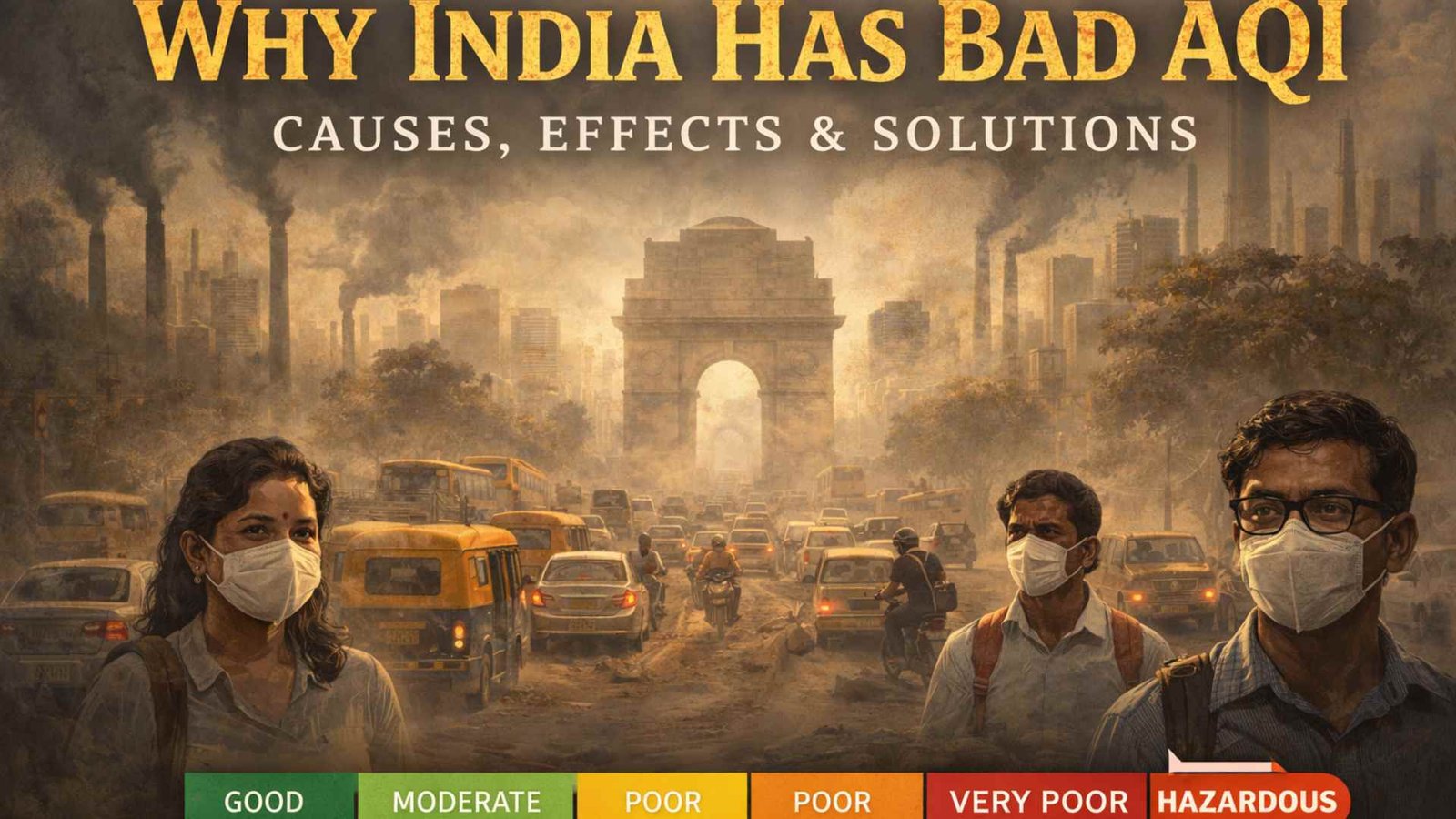
Why India Has Bad AQI – Causes, Effects & Simple Solutions
Air pollution has become one of the biggest environmental problems in India. Many Indian cities, including Delhi, Mumbai, Kolkata, and Lucknow, often record very poor or even hazardous AQI (Air Quality Index) levels. But why is the air quality in India so bad compared to many other countries? The answer lies in a mix of population pressure, pollution sources, weather conditions, and weak enforcement.
What Is AQI?
AQI (Air Quality Index) is a number used to show how clean or polluted the air is.
- 0–50: Good
- 51–100: Moderate
- 101–200: Poor
- 201–300: Very Poor
- 301+: Hazardous
Many Indian cities frequently cross 200–400+ AQI, which is dangerous for health.
Major Reasons Why India Has Bad AQI
1. Vehicle Pollution
India has crores of vehicles on the roads, many of them:
- Old diesel vehicles
- Poorly maintained engines
- Traffic jams causing continuous emissions
Vehicle smoke releases harmful gases like PM2.5, nitrogen dioxide, and carbon monoxide, which seriously damage air quality.
2. Construction Dust Everywhere
Rapid urban development leads to:
- Open construction sites
- Uncovered sand and cement
- Broken roads
- Poor dust control
This creates a large amount of PM10 and PM2.5 particles, which stay suspended in the air and enter our lungs.
3. Crop Burning (Stubble Burning)
Every year, farmers in Punjab, Haryana, and nearby states burn crop waste to quickly clear fields.
This creates thick smoke that travels to cities like Delhi and causes severe pollution spikes during winter.
4. Industrial Pollution
Many factories release:
- Smoke
- Chemicals
- Toxic gases
Although rules exist, not all industries follow pollution control norms strictly, especially in smaller industrial areas.
5. Use of Solid Fuels in Homes
In rural and low-income urban areas, many families still use:
- Wood
- Coal
- Cow dung cakes
- Kerosene
This indoor and outdoor smoke significantly adds to overall air pollution.
6. Weather and Geography
India’s weather also worsens pollution:
- In winter, cold air traps pollution close to the ground
- Low wind speed prevents pollutants from dispersing
- Cities like Delhi are landlocked, so pollution gets “stuck”
This is why AQI becomes extreme during October–January.
Health Effects of Bad AQI
Poor air quality affects everyone, especially children and the elderly. Common problems include:
- Breathing difficulty
- Asthma and bronchitis
- Eye and throat irritation
- Lung damage
- Heart problems
- Reduced life expectancy
Long-term exposure to polluted air is now linked to millions of premature deaths every year.
Why the Problem Is Worse in Cities
Indian cities suffer more because of:
- High population density
- More vehicles per km
- Constant construction
- Less green cover
- Concrete heat trapping
This creates a pollution + heat + dust trap.
What Can Be Done to Improve AQI?
Government Level:
- Stricter vehicle emission rules
- Better public transport
- Control on construction dust
- Ban on open waste burning
- Support alternatives to stubble burning
Individual Level:
- Use public transport when possible
- Avoid firecrackers
- Plant trees
- Save electricity
- Use air-purifying indoor plants
- Maintain vehicles properly
Conclusion
India’s bad AQI is not caused by a single issue but by multiple connected problems: traffic, dust, industry, farming practices, population pressure, and climate conditions. The good news is that with strong policies and public awareness, air quality can improve. Clean air is not a luxury — it is a basic right.
FAQ
Why is AQI so bad in Delhi?
Because of heavy traffic, construction dust, stubble burning, and winter weather that traps pollution.
Is India the most polluted country?
India often ranks among the top most polluted countries, especially in terms of city-level AQI.
Can AQI be improved?
Yes, with stricter laws, cleaner energy, better transport systems, and public participation.