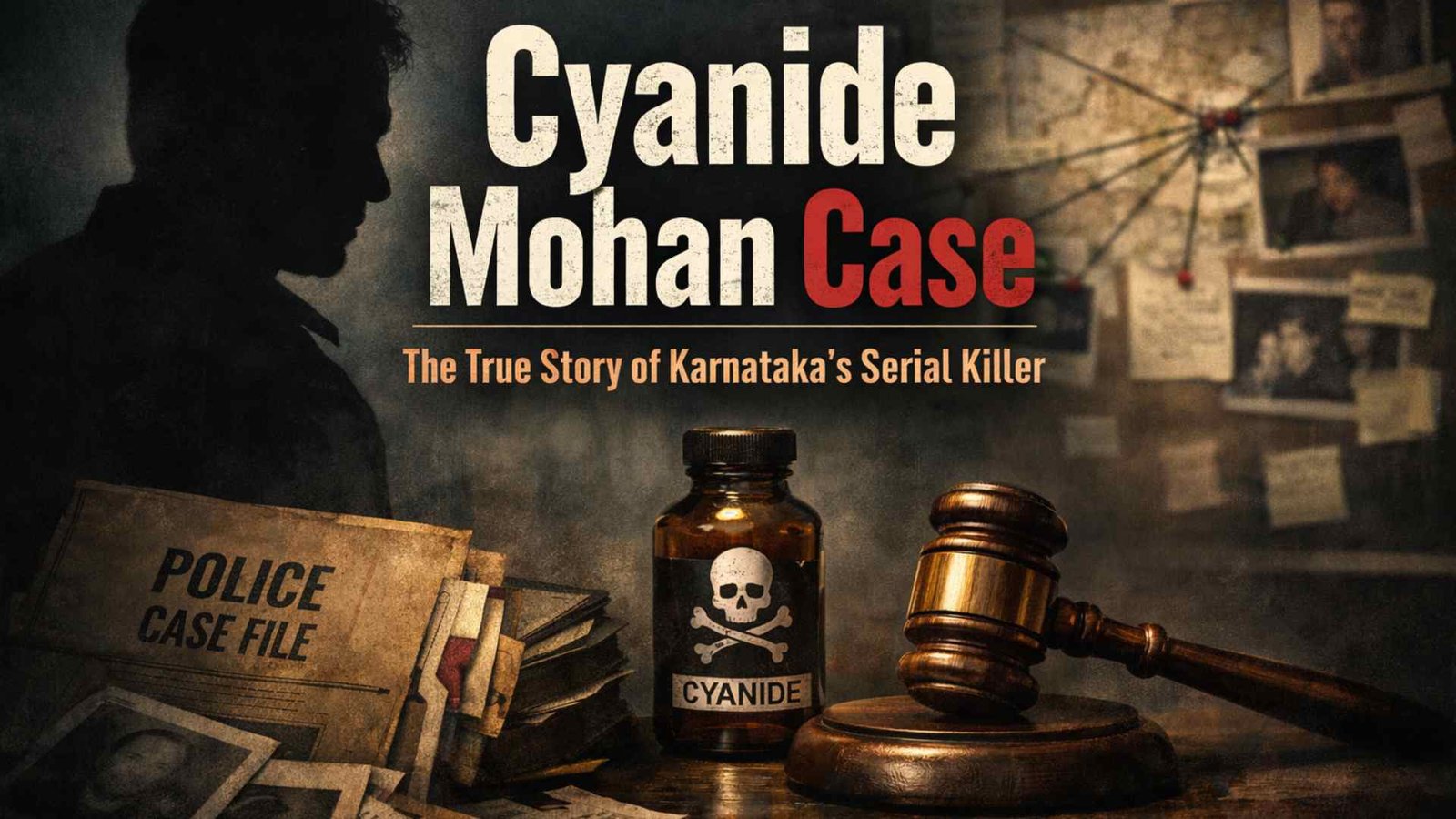
Cyanide Mohan: True Story of Karnataka’s Serial Killer
Note on sensitivity & accuracy: This article summarizes reported and court-record information about real victims and criminal proceedings. Wherever possible, it relies on established reportage and judgments, and avoids speculation.
Who was “Cyanide Mohan” (Mohan Kumar Vivekanand)?
Mohan Kumar Vivekanand, widely known in Indian media as “Cyanide Mohan,” is a convicted serial offender from Karnataka who became infamous for cases in which women were killed using cyanide after being lured with promises such as marriage or employment. (The Indian Express)
Media reports and court proceedings describe a pattern: victims—often women seeking stability or marriage—were allegedly approached under false identities and persuaded to travel, after which they were poisoned and robbed of jewelry. (The Indian Express)
Why the nickname “Cyanide Mohan”?
The nickname comes from the reported method of killing: cyanide administered to victims (often described as a pill). Cyanide is a fast-acting toxin that can be lethal in small doses, interfering with the body’s ability to use oxygen at the cellular level. (The Indian Express)
Modus operandi: how investigators say the crimes were carried out
Across reporting and court narratives, the alleged/established pattern included:
- Targeting women (commonly those seeking marriage or a better opportunity). (The Indian Express)
- Using deception and aliases to build trust (introducing himself with different names). (CaseMine)
- Getting victims to travel—often to bus stands, lodges, or other public places—on some pretext (job interview, temple/pooja, marriage plan). (CaseMine)
- Administering poison (cyanide) and then stealing gold/jewelry. (The Times of India)
This pattern mattered because it helped police link seemingly separate incidents and build repeat-offender evidence across cases. (The Indian Express)
Arrest and investigation timeline (high-level)
While different sources emphasize different cases, a commonly reported sequence is:
- 2004–2009: Period most frequently cited in major reporting for the series of crimes attributed to him. (The Indian Express)
- 21 Oct 2009: Widely reported arrest date. (The Indian Express)
- 2013: Trial court judgments in key cases (including death sentences in certain matters) were reported around this period; these were later subject to High Court review/appeals. (CaseMine)
- 2017: Karnataka High Court decision-making is reported in at least one prominent case as upholding a death sentence related to Sunanda’s murder (while other cases saw different outcomes, including commutation). (The Times of India)
- 2020: Further conviction/life sentence reported in later-numbered cases, reflecting the multi-case prosecution approach. (The Times of India)
Because this was prosecuted across many separate case files, “the final sentence” is best described as a set of outcomes across cases, not a single one-line result. (The Indian Express)
Court outcomes: what’s established in records and reporting
Trial court and High Court records/reporting show:
- In at least one major matter (Sunanda murder case), Times of India reported the Karnataka High Court upheld the death penalty in 2017. (The Times of India)
- A Karnataka High Court judgment record (appeal/reference context) documents the trial court’s convictions and sentencing framework in a key case, including the death sentence at the sessions court stage and the IPC sections involved. (CaseMine)
- Indian Express reporting (2020) describes that he was convicted in numerous cases, with some death sentences, and notes that outcomes differed across cases at the High Court stage (upheld in one, commuted in others). (The Indian Express)
How did cyanide factor into detection and prosecution?
Cyanide poisoning can be difficult to detect without timely medical and forensic work, especially when deaths occur away from hospitals. Toxicology and consistent investigative patterns (victim profiles, last-seen trails, jewelry disposal, travel/lodge records) are often key in building repeat-offender cases. (jistox.in)
Impact and broader context (why this case remains discussed)
The “Cyanide Mohan” cases continue to be referenced in discussions about:
- Predatory deception tied to marriage/employment promises
- Gaps in missing-person linkage across districts
- Need for stronger victim-safety systems (travel verification, community awareness, rapid missing-person escalation)
Popular culture has also drawn loose inspiration from the case, reflecting how deeply it entered public consciousness. (Wikipedia)
What is Cyanide Mohan’s real name?
He is commonly identified as Mohan Kumar Vivekanand (also reported as Mohan Kumar). (Wikipedia)
Why was he called “Cyanide Mohan”?
Because multiple cases attributed to him involved killing victims by administering cyanide. (The Indian Express)
When was Cyanide Mohan arrested?
Major reporting and summaries commonly cite 21 October 2009 as the arrest date. (Wikipedia)
What did the Karnataka High Court decide?
At least one widely reported High Court decision (Sunanda case) upheld a death sentence in 2017, while other cases saw different outcomes including commutation—reflecting the complexity of multiple trials/appeals. (The Times of India)
Research references (selected)
- Indian Express long-form reporting on the investigation, pattern, arrest, and multi-case outcomes. (The Indian Express)
- Karnataka High Court judgment record (case documentation of convictions/sentencing framework and appeal/reference context). (CaseMine)
- Times of India report on Karnataka High Court decision in the Sunanda murder case. (The Times of India)
- Times of India report on conviction in later-numbered cases (2020). (The Times of India)
- Toxicology/medical overview of cyanide poisoning (general scientific background). (jistox.in)